
Shahmeer Baweja
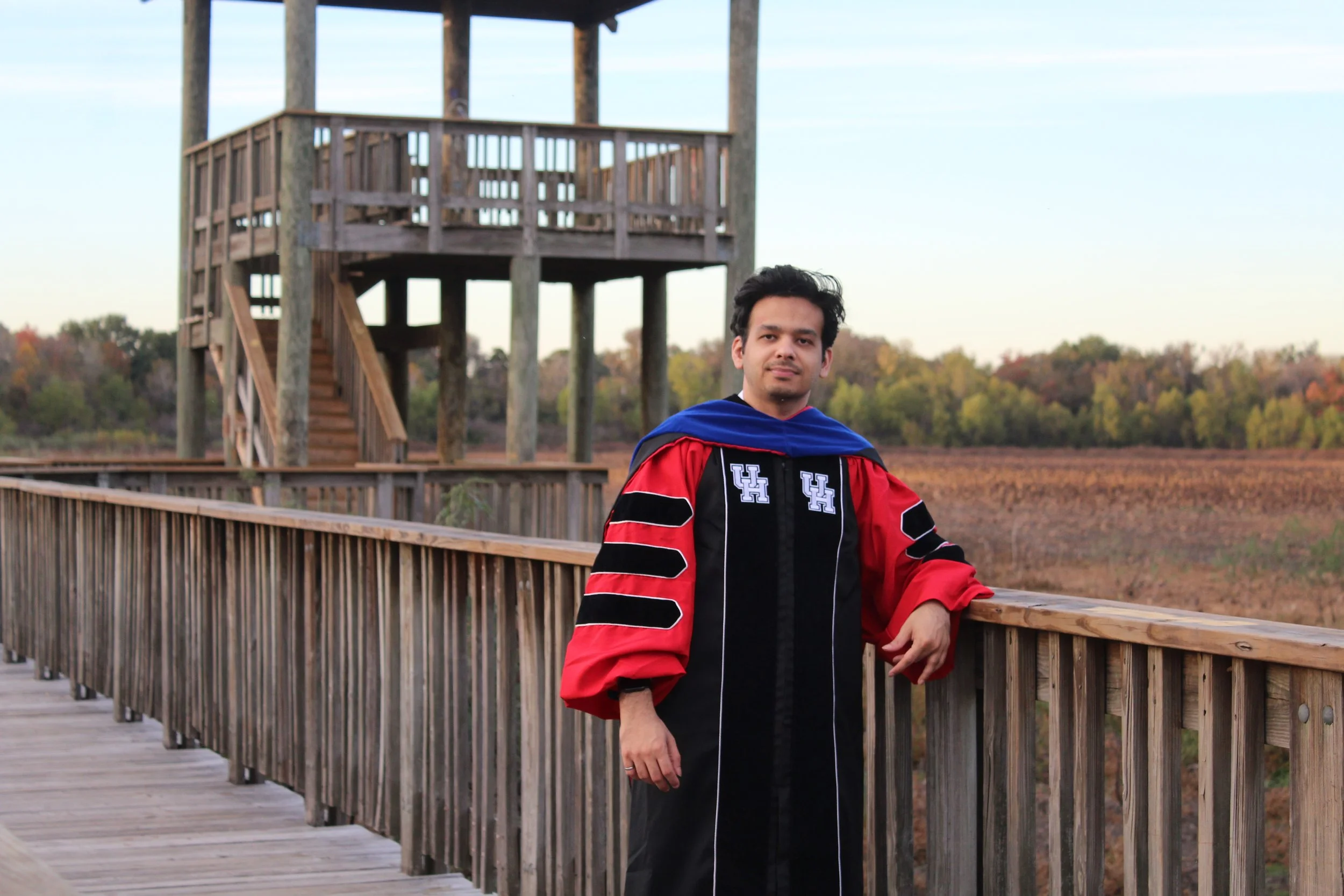
[Image Description]: Shahmeer wears PhD graduation robes while standing on a bridge overlooking a field.
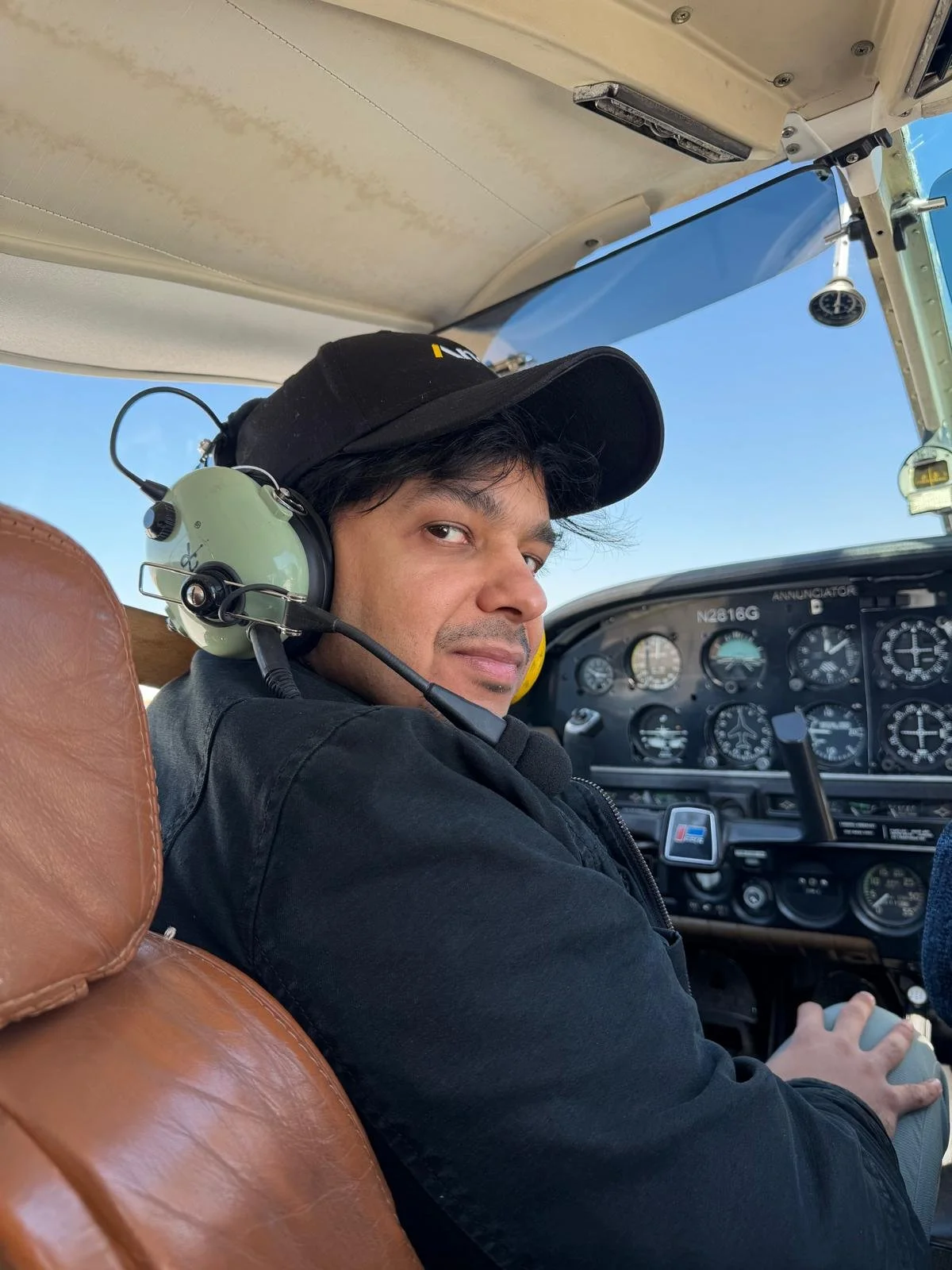
[Image Description]: Shahmeer looks over his shoulder while piloting a plane.
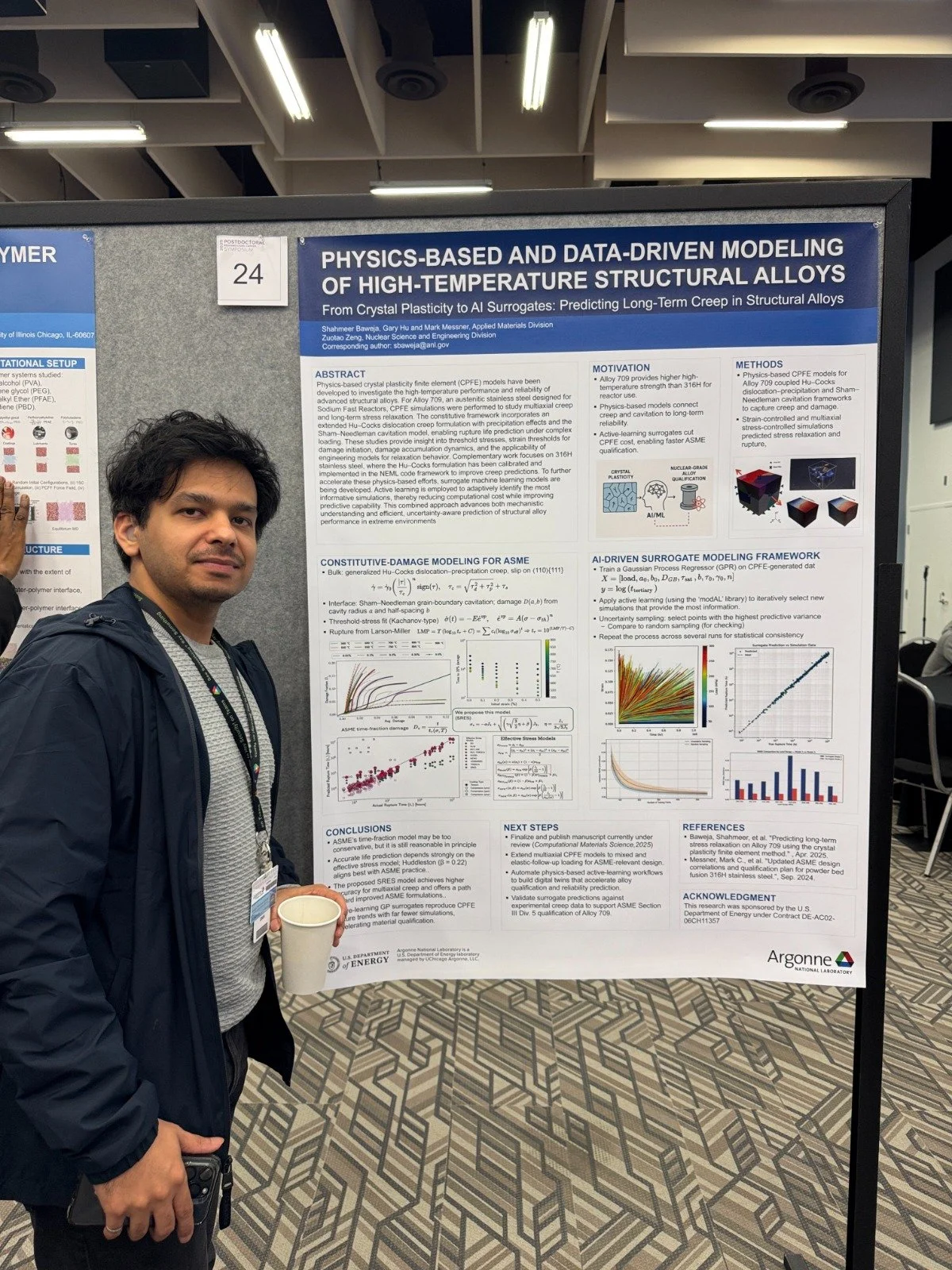
[Image Description]: Shahmeer poses in front of a research poster titled “Physics-Based and Data-Driven Modeling of High-Temperature Structural Alloys.”
(he/him)
Meet Shahmeer Baweja, the first known Deaf mechanical engineer from Pakistan to earn a Ph.D. in the United States, with research experience at a U.S. Department of Energy national laboratory, whose journey as a hard-of-hearing engineer with profound hearing loss reflects passion, perseverance, and a commitment to breaking barriers in STEM.
Learn more about Shahmeer on his website.
Follow Shahmeer on Instagram at @shahbawe.
Follow Shahmeer on LinkedIn.
What is your story?
My story is not simply about “overcoming” hearing loss. I have not defeated it, and communication barriers did not disappear when I earned a degree or became a researcher. My story is more about learning to navigate environments that were not always designed with people like me in mind, while gradually realizing that I should not have to solve every accessibility problem alone.
I was born in Karachi, Pakistan, with profound bilateral sensorineural hearing loss and began wearing hearing aids when I was very young. My parents, especially my mother, invested an enormous amount of time in my speech development, education, and confidence. I attended mainstream schools and communicated mainly through spoken language. My teachers also made an important difference. Some learned how to use my FM system, made sure I could see them while they spoke, and gave me extra support when needed. They gave me access without lowering their expectations.
Doing well academically became an important source of confidence. After achieving strong results in my school examinations, I was invited to appear on television in Pakistan. At the time, I was mostly excited about being on TV, but looking back, the moment meant something deeper. It reinforced an idea that has stayed with me throughout my life: hearing ability and intellectual ability are not the same thing.
I later moved to Houston to study mechanical engineering at the University of Houston. What began as an undergraduate degree became an eleven year journey through my bachelor’s, master’s, and Ph.D. studies. I became the first person in my immediate and extended family to earn a Ph.D. The university became a second home where I developed not only as an engineer and researcher, but also as someone learning how to advocate for access.
My professional journey was not perfectly smooth. I participated in engineering projects, joined Formula SAE, worked at an electric vehicle startup, conducted graduate research, attended career fairs, and went through many interviews. For a long time, I struggled to turn interviews into engineering opportunities. I cannot say that every rejection was related to disability, but when communication is already one of your greatest challenges, repeated rejection can make you question whether people are evaluating your technical ability or reacting to the way you speak.
After completing my Ph.D., I joined Argonne National Laboratory as a postdoctoral researcher. I used computational models to study advanced structural materials used in energy and nuclear applications. I ran large simulation studies, contributed to scientific publications and Department of Energy reports, collaborated with researchers from different backgrounds, and presented my work at technical meetings and conferences. I am now preparing to continue that journey through another postdoctoral role focused on additive manufacturing, computational mechanics, and improving the reliability of manufactured components.
Reaching these milestones did not make my hearing loss disappear. I still need captions in meetings. I still sometimes ask for a question to be repeated or written in the chat. I still prepare carefully before presentations and technical discussions. Success did not remove my disability. It showed what I could accomplish when I had the right combination of preparation, mentorship, opportunity, and access.
There is also a lot of invisible work involved in being Deaf or hard of hearing in STEM. Before an important meeting, I may review the subject, study unfamiliar terminology, prepare notes, anticipate questions, and check whether captions will be available. During the meeting, I might be listening through my hearing aids, lip reading, reading captions, looking at a slide, and thinking about my response at the same time. Most people only see the answer I eventually give. They do not see everything that happened in the few seconds before it.
For a long time, I thought I should handle these challenges quietly. I did not want to inconvenience anyone or make people think I was less capable. Over time, I learned that asking someone to turn on captions, face me while speaking, place a technical question in the chat, or share materials in advance is not asking for special treatment. It is simply explaining what allows me to participate on equal terms.
Disability is also only one part of who I am. I am an engineer and researcher, but I am also someone who enjoys cars, movies, documentaries, history, technology, working out, swimming, traveling, and trying different foods at different places. I can spend hours trying to understand why a simulation is producing a strange result and then spend just as long discussing a movie or how an everyday product could have been designed better.
I identify as Deaf and hard of hearing, and that is an important part of my life, but I do not want to be reduced either to my disability or to an inspirational story about overcoming it. Disabled people should not need to do something extraordinary to justify being included. We should be able to become students, researchers, engineers, professors, managers, inventors, and leaders.
The message I hope people take from my story is that accessibility and excellence are not competing goals. Captions did not earn my degrees. CART did not solve my equations. Written questions did not build my computational models, and hearing aids did not write my papers. These tools gave me access to the information. I still had to learn the material, solve the problems, perform the research, explain the results, and meet the same standards as everyone else.
When barriers are removed without expectations being lowered, disabled scientists and engineers can do far more than simply participate. We can contribute ideas, solve difficult problems, mentor others, lead teams, and help shape the future of STEM. That is the part of my story I hope people remember.
Tell us about your STEM. What do you do, what do you love about it, and what brought you to the field?
I am a mechanical engineer and computational materials scientist: I use computer simulations as virtual tests to understand whether mechanical products and components will perform safely and reliably. For example, before a part in a car suspension system is manufactured and used on the road, a simulation can show how it may respond to weight, vibration, repeated loading, heat, and unexpected forces. We can identify areas where it may bend too much, become damaged, or eventually fail, then use that information to improve the shape, material, or manufacturing process. That is what I love most about my work. A simulation is not just a collection of equations or a colorful image on a screen. It can reveal a weakness, explain why something failed, and help engineers create safer and more reliable products.
I grew up in Karachi, Pakistan, and enjoyed mathematics and physics from an early age. I liked solving problems and understanding why physical things behaved the way they did. I found it fascinating that equations could describe the motion of an object, the forces acting on a structure, or the way a material bends and breaks. Mechanical engineering felt like a natural choice because it connected those ideas to real machines, products, and structures. I later moved to Houston and earned my bachelor’s, master’s, and Ph.D. degrees in mechanical engineering at the University of Houston.
During my Ph.D., I studied lightweight magnesium alloys. Although a piece of metal may look smooth and uniform from the outside, it contains many tiny crystals inside it. I used computer models to study how those crystals deform and interact with one another, and how that behavior can eventually lead to damage in the larger material. After completing my Ph.D., I joined Argonne National Laboratory as a postdoctoral researcher, where I studied materials used in high temperature energy and nuclear systems. Some of these components may operate under heat and load for many years, so I used simulations to understand how the materials slowly deform, become damaged, and eventually fail.
I am now preparing to begin a second postdoctoral role connected with the Center for Agile and Adaptive Additive Manufacturing at the University of North Texas, working with researchers at Texas A&M University. The project focuses on improving materials and components made through three dimensional printing, including parts for medical applications. The printing process can sometimes create small internal defects that affect how long a component lasts. I will use simulations alongside experimental results to study how those defects and the internal structure of the material influence fatigue, which is damage caused by repeated loading. The goal is to improve the manufacturing process so that printed components have fewer defects, last longer, and perform more reliably.
I am also interested in combining engineering simulations with machine learning. Detailed simulations can take a great deal of time, especially when many materials, designs, or manufacturing conditions need to be studied. Machine learning can help identify patterns, make faster predictions, and determine which simulations or experiments would be most useful. I still want those predictions to remain connected to real engineering principles rather than treating the technology as a mysterious black box.
A lot of computational research feels like detective work. When a result does not make sense, I examine the model, assumptions, data, and code until I understand what happened. My hearing loss has also shaped this approach. Because I have always relied heavily on visual information, written materials, preparation, and careful observation, I tend to break complicated problems into smaller parts, document my work carefully, and keep looking at a problem from different directions until it makes sense. What motivates me most is knowing that a simulation can identify a weak point, improve a design, explain a failure, or prevent a future problem. That connection between computer simulations and safer, more reliable products is what I love most about my field.
What accessibility tools support you to thrive?
I was born with profound bilateral sensorineural hearing loss and have worn hearing aids since I was very young. They help me hear and communicate through speech, but they do not make everything perfectly clear. Fast speech, unfamiliar accents, noisy rooms, and several people talking at once can still be difficult for me to follow. Because of that, I rely on a combination of hearing aids, lip reading, captions, written information, and visual cues.
Being able to see the person speaking makes a major difference. I naturally lip read, so one on one conversations are usually easier than large group discussions. If people begin talking over one another, I can lose track of the conversation quickly. Facing me, speaking clearly, and allowing one person to speak at a time are simple things that help a great deal.
At the University of Houston, one of my most important accommodations was CART, or Communication Access Realtime Translation. A captioner typed what the professor was saying as the lecture happened, and I followed the text on a screen. In an engineering course, missing one technical word, equation, or instruction can affect everything that follows. I would listen through my hearing aids, watch the professor and the board, and read the captions at the same time. Over time, that became a normal part of how I learned.
During my Ph.D., especially when meetings moved online during the COVID 19 pandemic, I began using Otter.ai and the built in captions in Microsoft Teams and Zoom. In a virtual meeting, I often listen, watch the speaker, and read the captions at the same time. If someone asks a technical question, I may hear part of it, understand more through lip reading, and use the captions to confirm the exact wording before I respond.
Captions are extremely helpful, although they are not always accurate with scientific terms, acronyms, material names, or equations. Sometimes a technical word appears as something completely unrelated. In those situations, it helps when the key term or question is also written in the chat. For longer questions during interviews, presentations, or research meetings, I may ask for the wording to be placed in the chat so I can be sure I am answering the question that was actually asked.
Receiving slides, agendas, papers, or important terminology in advance also helps me prepare for a discussion. Written follow ups are useful for confirming decisions, responsibilities, and next steps. I also appreciate when people are comfortable repeating or rephrasing something without making it awkward. Speaking louder does not necessarily make speech clearer. Facing me and saying the sentence in a different way usually works better.
For me, accessibility means having more than one way to receive information. Hearing aids, lip reading, captions, visible speakers, written questions, and preparation all work together. None of these tools makes the engineering easier. I still have to understand the material, solve the problem, run the simulations, explain the results, and meet the same expectations as everyone else. They simply give me reliable access to the information I need to do that.
What do you want people to know about being disabled in STEM?
The main thing I want people to understand is that disability is not the same as incompetence. I may communicate or receive information differently, but that has nothing to do with my ability to understand mechanics, mathematics, programming, or materials science.
With profound hearing loss, the biggest barrier is often not the science itself. It is access to the conversations around the science. If several people are speaking at once, I may miss part of a technical question. In engineering, one missed word can completely change the meaning. Tension and compression, stress and strain, or 600 and 800 degrees are very different things. I may know the subject well, but I cannot give the right answer if I receive the wrong question.
There is also a lot of invisible work involved. Before a meeting, interview, or presentation, I may review technical terms, organize notes, anticipate questions, and check whether captions will be available. During the discussion, I may be listening through my hearing aids, lip reading, reading captions, looking at a slide, and thinking about my response at the same time. Most people only see the answer I give, not all the preparation behind it.
Accessibility does not mean lowering expectations. I do not want an easier engineering problem because I am hard of hearing. Captions do not run my simulations, CART did not pass my courses, and a written question does not give me the answer. These tools simply give me access to the same information so that I can be evaluated on what I actually know.
I also believe accessibility should be treated as part of good scientific practice, not as a special favor. Captions, clear slides, written instructions, one person speaking at a time, and meeting summaries often improve communication for everyone.
Sometimes exclusion is subtle. A disabled person may be invited into the room but still be unable to participate fully in the conversation. Real inclusion means having the access needed not only to enter STEM, but also to contribute, advance, and lead. Disabled people should be able to become researchers, professors, senior engineers, managers, inventors, and technical leaders.
Most of all, I do not want disabled scientists to be admired simply for overcoming unnecessary barriers. I would rather see more of those barriers removed.
Give people access to the information, keep the expectations high, and evaluate them on what they can actually do. That is what inclusion in STEM means to me.
What advice would you give to someone with a disability looking to enter your STEM field?
My first piece of advice is not to decide that a technical field is closed to you before you have had the chance to try it. Other people may already make assumptions about what you can or cannot do because of your disability. You do not need to make those assumptions for them.
When I was younger, I sometimes wondered whether someone with profound hearing loss and speech differences could realistically succeed in engineering. Engineering involves lectures, presentations, interviews, group projects, and fast technical discussions, all of which can be challenging for me. But mathematics, physics, programming, and mechanics did not become less understandable because I was hard of hearing. Once I had access to the information, I could do the work. Difficulty accessing information is not the same as difficulty understanding it.
Build confidence by developing a strong technical foundation. Learn the fundamentals of your field as deeply as you can, whether that means mathematics, programming, design, experiments, or laboratory work. There were times when I left an interview or presentation doubting myself because communication had been difficult. I had to learn not to confuse a communication barrier with a lack of technical ability.
It is also important to understand what helps you perform at your best and to communicate those needs clearly. That might mean live captions, a technical question written in the chat, slides shared in advance, a clear view of the speaker, one person talking at a time, or the option to provide part of a detailed response in writing. Ask for support early rather than waiting until you are already struggling.
At the University of Houston, CART captioning gave me access to lectures. Later, tools such as Otter.ai and live captions helped me participate in research meetings and seminars. I do not see those tools as shortcuts. Engineers use tools constantly, and accessibility technology is simply another tool that allows someone to do their best work.
Good mentors also make a major difference. My teachers, disability services staff, research colleagues, and especially my Ph.D. advisor all helped me grow. A good mentor recognizes your potential, gives honest feedback, and helps you improve. Connecting with other disabled people in STEM can also help you realize that something you viewed as a personal weakness may actually be a common accessibility problem.
Pay attention to the culture of the places where you study or work. No university or workplace will be perfect, but there is a difference between people who are willing to learn and people who repeatedly ignore reasonable accessibility needs. Do not become discouraged if your path takes longer than expected. Mine certainly did. I went through many applications, interviews, and rejections before reaching my postdoctoral position at Argonne. Progress often comes through small improvements rather than one dramatic breakthrough.
Keep a record of the projects you complete, code you write, presentations you give, problems you solve, and people you help. You also do not have to turn your life into an inspirational story. You are allowed to be ambitious, frustrated, curious, imperfect, and still learning.
Develop your skills, ask for the access you need, use technology without guilt, and find people who support your growth. Asking for access is not admitting weakness. It is creating the conditions in which your actual abilities can be seen.
What tools do you wish were made available to you when navigating STEM?
I wish accurate real time captioning had been available everywhere throughout my education, rather than only in certain classrooms or situations where it had to be arranged in advance. When I was younger, I relied mostly on hearing aids, lip reading, an FM system, and support from my teachers. Those tools helped, but I could still miss information when several people spoke at once or when someone talked while facing away from me. Later, at the University of Houston, CART captioning made a huge difference because I could read lectures as they happened.
I also wish recorded lectures, seminars, and technical presentations had routinely included accurate captions and searchable transcripts. In engineering, missing one word can completely change the meaning of a question or instruction. Being able to search a transcript afterward would make it much easier to confirm exactly what was said and review difficult technical concepts.
AI is creating exciting possibilities for people with hearing loss. Tools such as Otter.ai and the live-captioning features in Microsoft Teams and Zoom already help me follow meetings, and Otter.ai in particular often produces strong transcripts. However, even these tools can become less reliable when conversations involve highly specialized scientific terminology, equations, unfamiliar names, heavy accents, or several people speaking at once. I would like an AI system that could be trained to recognize technical language, identify each speaker, connect the captions with the relevant presentation slides, and produce an accurate, searchable transcript of the entire discussion.
It would also be helpful if someone could upload slides, papers, or a list of key terms before a meeting so the system could learn the vocabulary in advance. After the meeting, AI could summarize important decisions, questions, responsibilities, and next steps. That would help someone with hearing loss confirm that nothing important was missed.
AI could also make conferences and networking more accessible. A phone, tablet, or wearable device could provide live transcription during a poster discussion, identify who is speaking, and allow someone to type a question when the room is too noisy. These tools could make informal conversations more accessible, since those are often the situations where captions are least available.
Beyond captioning, I wish written laboratory procedures, visual demonstrations, captioned videos, and clear safety instructions had always been standard. Missing a verbal instruction in a laboratory can affect both the experiment and safety.
Most of all, I would like accessibility to be built into STEM environments from the beginning instead of being treated as a special request. AI has great potential, but the tools need to be accurate, affordable, secure, and reliable with technical language. The goal is not to make engineering easier. It is to make sure people with hearing loss receive the complete information they need to do the same work and meet the same standards as everyone else.
