
Sheila Xu
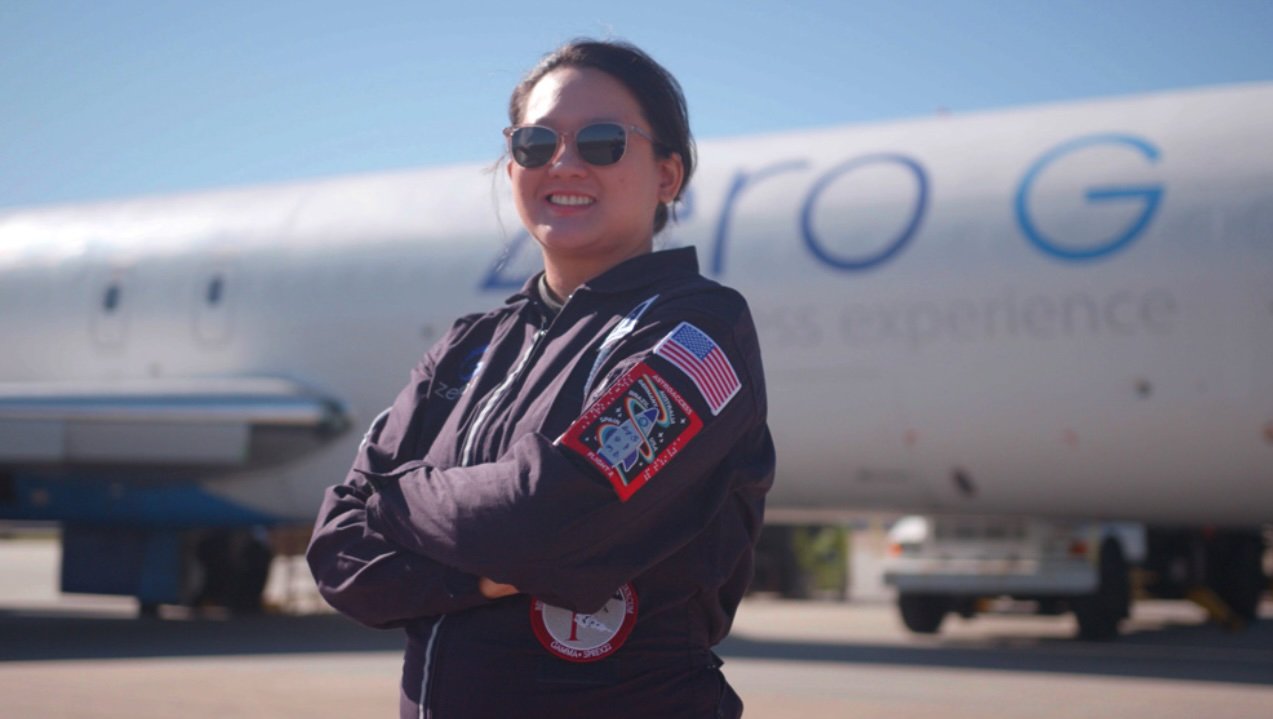
[Image Description]: Sheila poses next to the Zero Gravity plane in an AstroAccess flight suit. Her arms are crossed and she wears aviator sunglasses while smiling at the camera.

[Image Description]: Sheila smiles at the camera while piloting a plane. She is wearing a purple tank top, glasses, and a pilot’s headset.
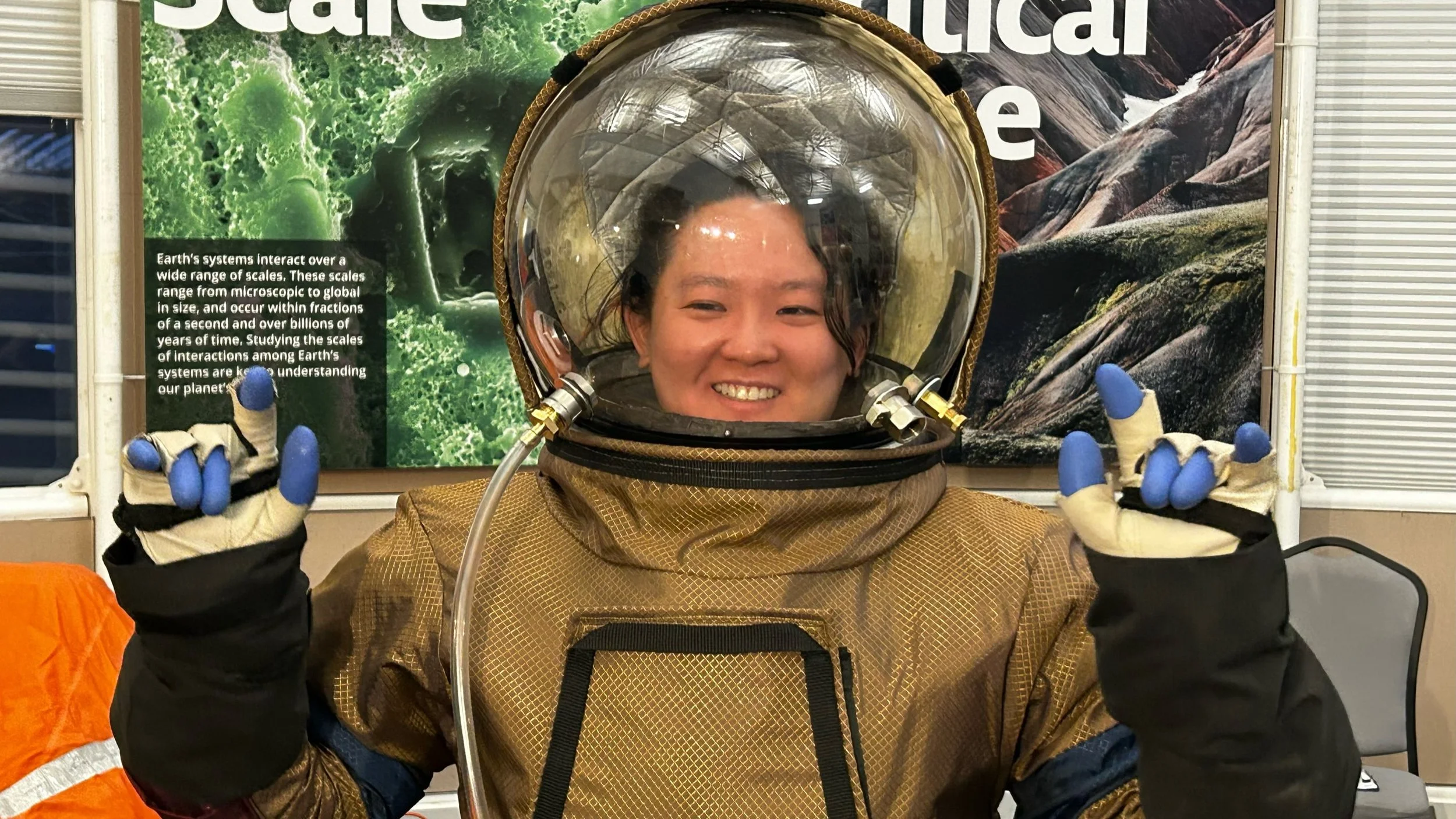
[Image Description]: Sheila signs using ASL while wearing a space suit and completing analog space training.
(she/her)
Meet Sheila Xu, the first Deaf Asian female pilot, a researcher, and aspiring astronaut working in accessible space research.
Follow Sheila on Instagram at @sheilazxu
What were your early experiences with STEM that inspired you to pursue the field?
My first exposure to STEM was from my father, who studied nuclear physics. He was a Chinese immigrant who moved to the US to do his PhD. My dad was really a nerd; he had degrees in math, computer science, and physics. My mom was also an immigrant from China who had moved to the US for education. They met, got married, and I was born and lo and behold, I was Deaf. I was the first Deaf person they had ever met; they’d had no exposure to Deaf people at all. They were trying to figure out what to do with their Deaf child, and also grieving, because they had envisioned what my future might look like as a Deaf person. How would I function? How would I thrive in this type of world?
My parents invested a lot in my early education. My dad taught me a lot of STEM concepts, and we would do physics-based projects together. We did a middle-school science fair project together, and won first place - I was really inspired by my early exposure to STEM. I was also influenced by the STEM culture, narratives, and media. My dad and I watched a lot of Star Trek together growing up. It was one of the few shows with captioning, so it was accessible to me. As I followed the adventures of Captain Kirk and Mr. Spock, I wanted to be like them: I wanted to explore! That sparked my interest in science, so I decided I wanted to become an astronaut.
At that time, Deaf people weren't allowed to be astronauts because they had really stringent requirements that they wouldn't accept anyone with any disabilities. But what could I do? I was just a kid. So, I put my dream on hold for a while.
After high school, I was accepted to my dream university, MIT. I studied science with two majors: Earth, Atmospheric, and Planetary Science and a humanities-based program in Science, Technology, and Society. This program mainly looked at how science, technology, and people interact and influence each other. I got the best of both worlds, having both STEM and humanities perspectives. Through those humanities classes, I also had the opportunity to study different fields, like business and economics.
I did an internship at the NASA Jet Propulsion Laboratory, building a sea-level rise forecasting model to see what the future might look like for California’s sea level. Then I wanted to try something different, so I focused on economics research for my senior research, looking at how Deaf people run businesses: how they communicate with their Deaf or hearing customers, and how they manage in their country of origin.
After college, I had an invitation to go to Belgium and present my senior thesis. I decided to backpack through Europe solo. When I came to Italy, I met a Deaf Italian man, and we started dating. I decided to move to Italy to experience life in another country, learn a new language, and experience a new culture. I applied for fellowships and received a Fulbright Scholarship and a two-year visa to live here. I taught ASL and Deaf culture in Venice and did some research on Deaf business owners in Italy
What brought you back to the field of STEM?
When COVID hit, I felt stagnant. I felt like I wasn't growing anymore. I decided to go back to grad school and completed two master’s programs at the same time. There was a special partnership between Harvard and Wharton that allowed you to do a three-year program and get degrees from both. It was very interesting, and there was a lot of privilege involved with getting into those types of spaces.
It was during this time at Harvard that I had a class that discussed space policy. I learned that space has changed a lot since I was a kid. There are many private businesses involved now; the industry is less reliant on NASA and government agencies. That’s when I learned about a nonprofit organization called AstroAccess, who had posted that they were looking for disabled researchers to join their parabolic flight research. Between my class at Harvard and seeing the post about AstroAccess, I felt like the universe was trying to tell me something. I applied and was accepted to join the AstroAccess research team, and Harvard gave me the opportunity to really get involved with space policy and industry at the same time. I was able to get back into the STEM world.
Tell us about your experiments with AstroAccess.
I worked on the AstroAccess’ second zero-gravity parabolic research flight , a typical Boeing 727 with all of the seats removed and padded instead. The flight follows a parabolic motion: while flying up, you feel hypergravity, and at the top of the parabola, there is about 30 seconds of zero G. That’s the time we had to conduct our experiments. Then you start going back down, and it repeats 15-30 times. The purpose of these parabolic flights was to demonstrate that space vessels can be more accessible to people with various disabilities.
I worked with a crew of Deaf and hard-of-hearing individuals. There was also a crew of Blind and low-vision individuals who looked into how space vessels could best accommodate Blind astronauts. We also had a group with physical disabilities, with their own experiments. My group tested a light system, which would warn us when gravity was changing. That’s something pilots would normally call out, but Deaf people don’t hear those warnings, so we tested lights that changed colours instead. It turned out to benefit everyone on the plane, because, depending on the conditions, almost no one could hear the pilots. That was a nice example of universal design - yes, it benefited the Deaf and hard-of-hearing crew, but it benefited everybody.
We also communicated in ASL in off-nominal positions (meaning someone was upside down or sideways) to see if we could still understand each other in different orientations. Long story short: we can. As long as we have eye contact, we can understand each other. We also tested personal hearing software solutions, in which we, as individuals, decided how we wanted to improve our hearing comprehension in loud environments. Each Deaf person teamed up with a hearing person who would vocalize a list of words with no ASL or captioning. The Deaf person had to try their best to understand them. For those with cochlear implants and hearing aids, we had to make sure they stayed on in 0-G.
It was really an enjoyable experience working with AstroAccess. It gave me the opportunity to get back into STEM and the space industry. In the past, I wanted to become an astronaut, but I couldn’t; the policy wouldn’t allow it. But times have changed, and now there’s a potential for it. I never really gave up; I was just waiting for the right time and the right opportunity. We need to show that people with disabilities can be astronauts, and we do these types of experiments to provide proof that people with disabilities can work in space and contribute to risk reduction and improvements of emergency protocols.
I’m still working with AstroAccess: I’ve become their Director of Development. I also support the business side, building relationships and partnerships, and seeking grants and funding. It’s not as fun or as sexy as the research, but it’s still important. We need funding for the research, so I wear both hats!
What advice would you give to your younger self or to someone with a disability just starting their STEM journey?
Study hard. Definitely study hard, and get good grades. And it’s really important to network. Don’t invest all your time in studying. It's really important to invest your time going out, meeting people, and networking. If someone invites you to go to a social event, say yes. Socials are one of the best places to build relationships with people, especially in non-formal, non-stuffy environments like a conference. At social events, people are more laid back and relaxed; you can see more of the real people you’re talking to.
As a Deaf person, I'm very aware that networking is a big barrier. Networking is key to promotions, career growth, and even getting a job. But how can Deaf people connect with hearing people without access already set up? I tell Deaf students, and students with disabilities in general, to search for any opportunity they can to go out and network. It's important that you know your work, it's important you know the science, but relationships with people, those are people who would be hiring you. They're the ones who may look for funding opportunities for you. They may fund your work.
How can universities support community building and networking events for students with disabilities?
If you're running an event, you need to clearly indicate what type of accessibility services you will provide. You need to allow Deaf participants to bring their preferred interpreter, and provide interpreters in general. Although first, you need to make sure you have funding for that! You can always reach out to event organizers and indicate that you have students with accommodation needs who want to be part of an event, and work together to make it accessible to them.
My university always provided me with full access, meaning I could go to any networking or social event. I had two interpreters with me at all times. But I understand that might not be feasible for every university to provide that level of accessibility.
The key is: are you willing to provide accessibility, and do you have the funds to cover it? That’s the most important part, because without funds, I can’t access those spaces. It’s really important for institutions to invest in accessibility and guarantee the best educational experience possible for all their students.
What supports for STEM accessibility do you dream of?
I've been in these types of situations because I've been to some of the top American universities (Harvard, Wharton, and MIT) - these types of universities have billions of dollars. They can’t claim they don’t have funding for accessibility. When I was accepted, I would think about what my ideal accessibility setup would look like, and I came up with an extensive list of my access requirements.
At MIT, in my undergrad, I didn’t have interpreters with me all day; they were just provided for classes and specific events. In between, I didn’t have interpreters, and I was really just trying to survive MIT’s tough curriculum! I spent most of my time in my dorm or in the library, trying to figure out my problem sets and STEM concepts. There was not a lot of social interaction there as compared to grad school.
Graduate school for policy and business was much easier than studying STEM (for me), but it was a different type of challenge as it required constant communication: there were workshops, classes, presentations, networking, and socials. Yes, I still studied, but a lot less than in undergrad - I spent more time networking with people. I knew a Deaf student who had studied there before me, and they shared everything they went through and what types of events and programming I could expect. I realized that with the constant requirements for communication, I would need interpreters with me the entire day. Another Deaf student at Yale shared that they had a rotating team of interpreters, so that’s what I had assigned to me. I had two interpreters during the day, and then another team for the evenings. I also told both Harvard and Wharton that I wanted them to hire a full-time Interpreter Coordinator who was responsible for scheduling and subbing interpreters if anything came up - that was not something I wanted to manage while also focusing on my educational experience. They agreed to that, and it really took a load off me as I didn’t have to worry about that.
For classes, I asked for a few other things: I had two interpreters who would switch off and an in-person CART [Communication Access Realtime Translation] provider. I didn’t want a remote one, as too many things can go wrong there! My schools could afford this, although they struggled to find an in-person CART provider; there’s not a lot of incentive for them to come to campus in-person. I suggested that the university raise its rates, and as soon as they did that, they found someone right away. That’s what I mean by investing in accessibility and education for Deaf and hard-of-hearing students. And in order to do that, you need funding. And sometimes you may need to increase your rates to attract good people.
